

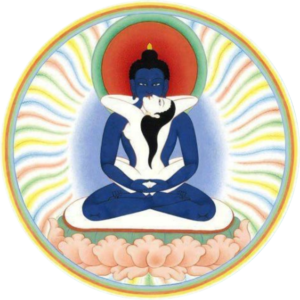
Kuntuzangpo (Samantabhadra) is not “first” in time but beyond time altogether. He represents ye nas lhun grub—primordial, spontaneous presence that was never fabricated, improved, or corrupted. In Dzogchen, enlightenment is not something to be achieved; it is something to be recognized.
In this tradition, Samantabhadra is rigpa itself—naked, self-knowing awareness that does not divide into subject and object. The moment the mind grasps or conceptualizes, it has already moved away from this original “face.”
The sky-like metaphor is essential. Thoughts, emotions, and karmic patterns are like clouds, not stains. No matter how dense they appear, they never alter the sky’s true nature.
In iconography, he is depicted naked and deep blue, symbolizing total openness and the infinite expanse of the dharmakāya. When shown in union with Samantabhadrī, the image expresses the inseparability of awareness (rigpa) and emptiness (śūnyatā)—clarity and space as one taste.
He is called the source of all Buddhas not in a theistic or creator sense. Rather, all Buddhas awaken by recognizing what Samantabhadra already is. He is the ground (gzhi), not a being who acts.
In short, Kuntuzangpo is not an object of devotion to become; he is what practice is meant to uncover as already present. The radical insight of Dzogchen is that the finish line was never ahead of you—it has always been here.