

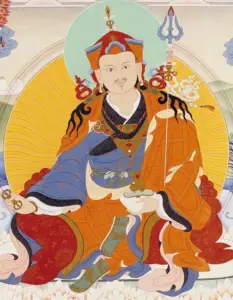
Padmasambhava, widely known as Guru Rinpoche (“Lotus-Born”), was an 8th-century Buddhist master who played a vital role in establishing Buddhism in Tibet. According to tradition, he miraculously appeared on a lotus in Lake Dhanakosha, often identified with a region in present-day Pakistan or Afghanistan.
Invited by the Tibetan king Trisong Detsen, Guru Rinpoche helped establish Buddhism firmly in Tibet. He assisted in the construction of Samye Monastery, the first Buddhist monastery in Tibet, and subdued local forces believed to be obstructing the spread of the Dharma.
He transmitted profound teachings, especially those of Vajrayana (Tantric Buddhism), and is regarded as the founder of the Nyingma school, the oldest tradition of Tibetan Buddhism.
Revered as the “Second Buddha,” Guru Rinpoche is also believed to have concealed numerous spiritual teachings, known as terma, to be revealed by future masters at the appropriate time. His wisdom, compassion, and transformative methods continue to inspire millions of practitioners throughout the Himalayan world.